
Bigger Movie Nights, Less Small Talk, No Weather Guesswork | Vol. 46
Five editorially chosen picks: one hero, three supporting acts, and one wildcard. This drop is designed to be browsed as a full collection, not just a pile of affiliate links.
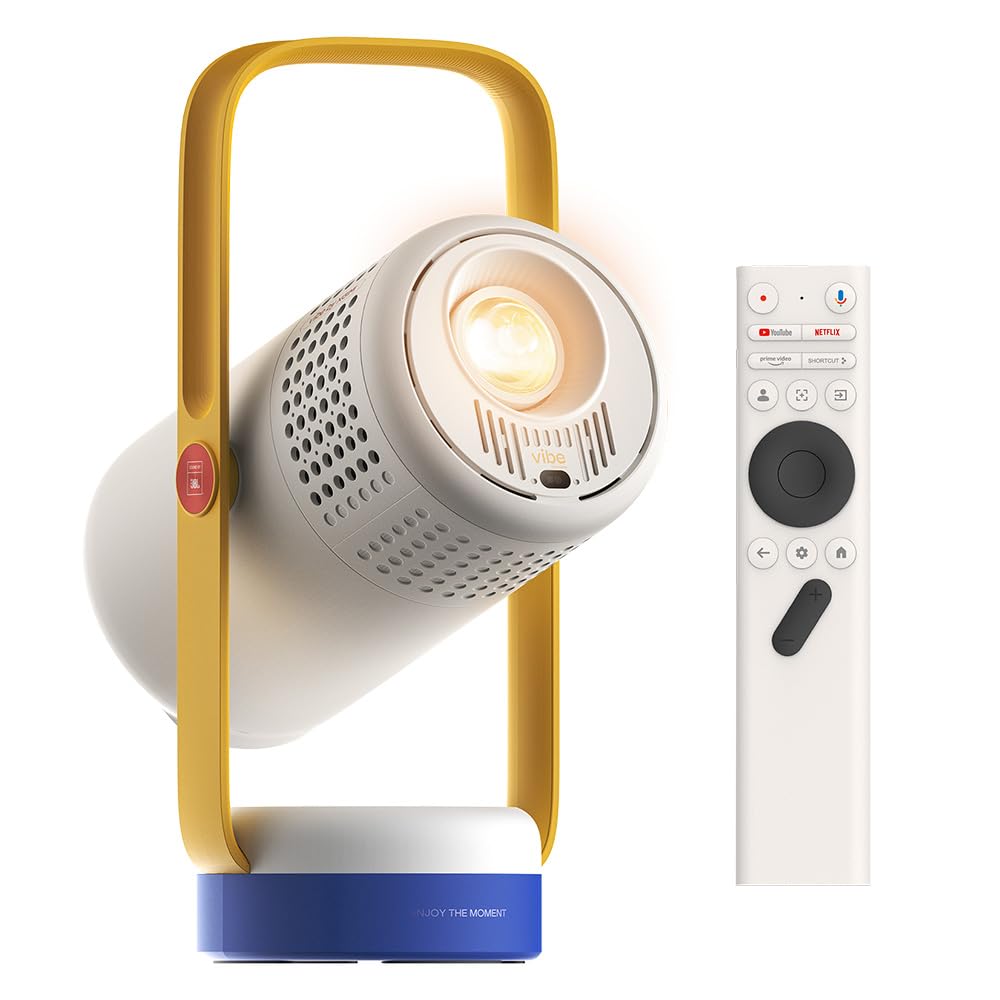
Hero Pick
XGIMI Vibe One Battery-Powered Portable Projector
A portable 1080p LCD projector with a built-in battery, automatic focus and keystone correction, and a 160° stand that doubles as a carry handle. Its adjustable design makes temporary viewing appealing; its battery is better suited to an episode than a movie night.
At a glance
Everything in this drop
XGIMI Vibe One Battery-Powered Portable Projector
A portable 1080p LCD projector with a built-in battery, automatic focus and keystone correction, and a 160° stand that doubles as a carry handle. Its adjustable design makes temporary viewing appealing; its battery is better suited to an episode than a movie night.

CMYK Wavelength Party Game
CMYK Wavelength is a two-team social guessing game for 2–12 players, built around clues that place a hidden target between two opposing concepts. Your team tries to guess where you mean—a modest request until everyone discovers they interpret the same clue differently.

Netatmo Indoor Outdoor Weather Station
A two-module weather station that measures indoor and outdoor temperature and sends both sets of readings to a Netatmo account over Wi-Fi. The indoor module also measures mean sea-level pressure. Useful for putting actual numbers behind the household debate about whether it’s colder outside.
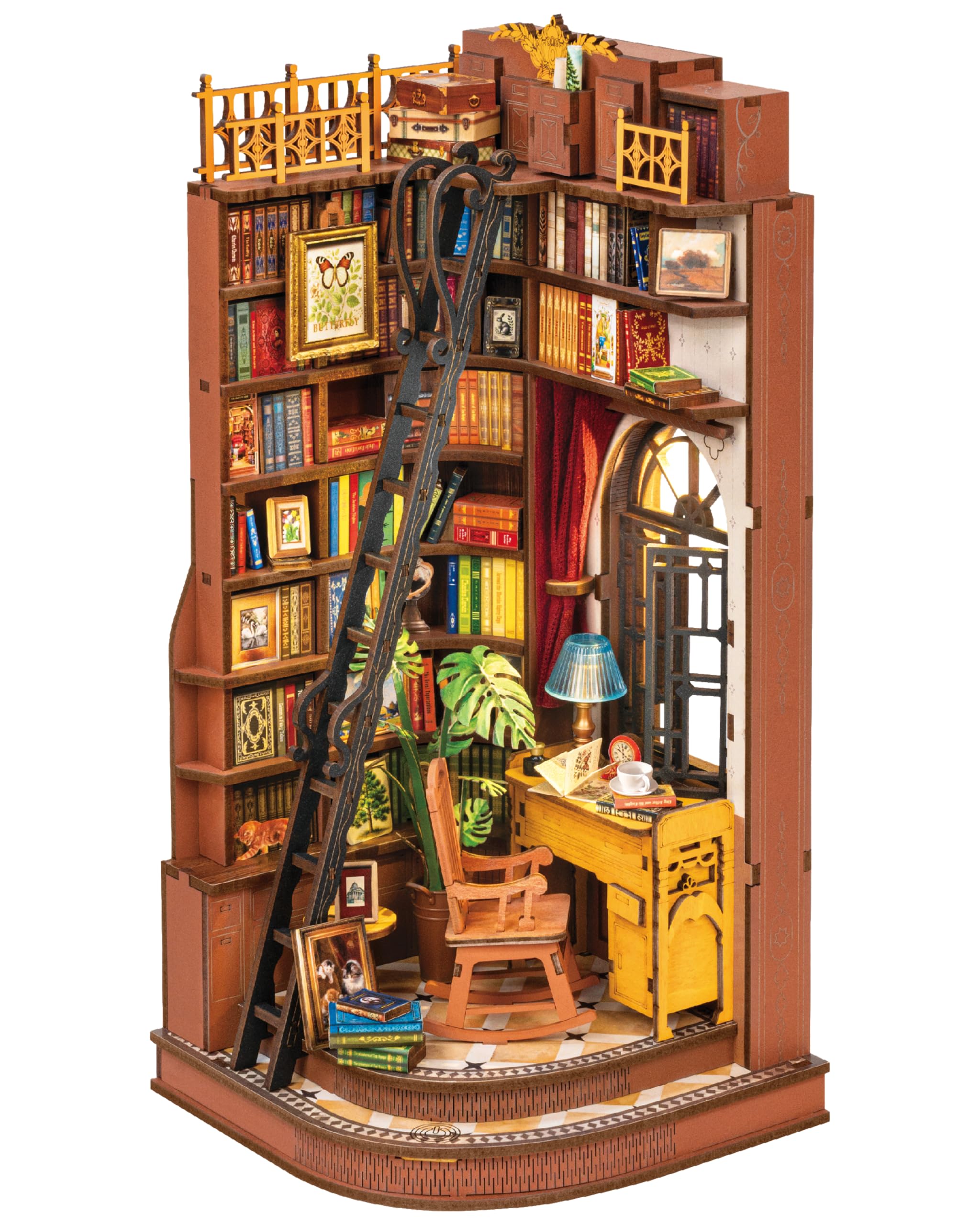
Rolife Silent Corner Study Book Nook Kit
A 196-piece wooden DIY book nook depicting a miniature study/library scene. The Rolife Silent Corner Study TGE02 turns a little shelf space into a room devoted to books—an appropriately recursive project for someone whose shelves are already full of them.

Atari 2600+ Retro Game Console
The Atari 2600+ plays most Atari 2600 and 7800 cartridges through HDMI, pairing an old-fashioned cartridge slot with modern emulation. A CX40+ joystick and 10-in-1 cartridge come included. It preserves the part of retro gaming that involves actually picking something off a shelf.
Deep dive
Why each pick earned its place
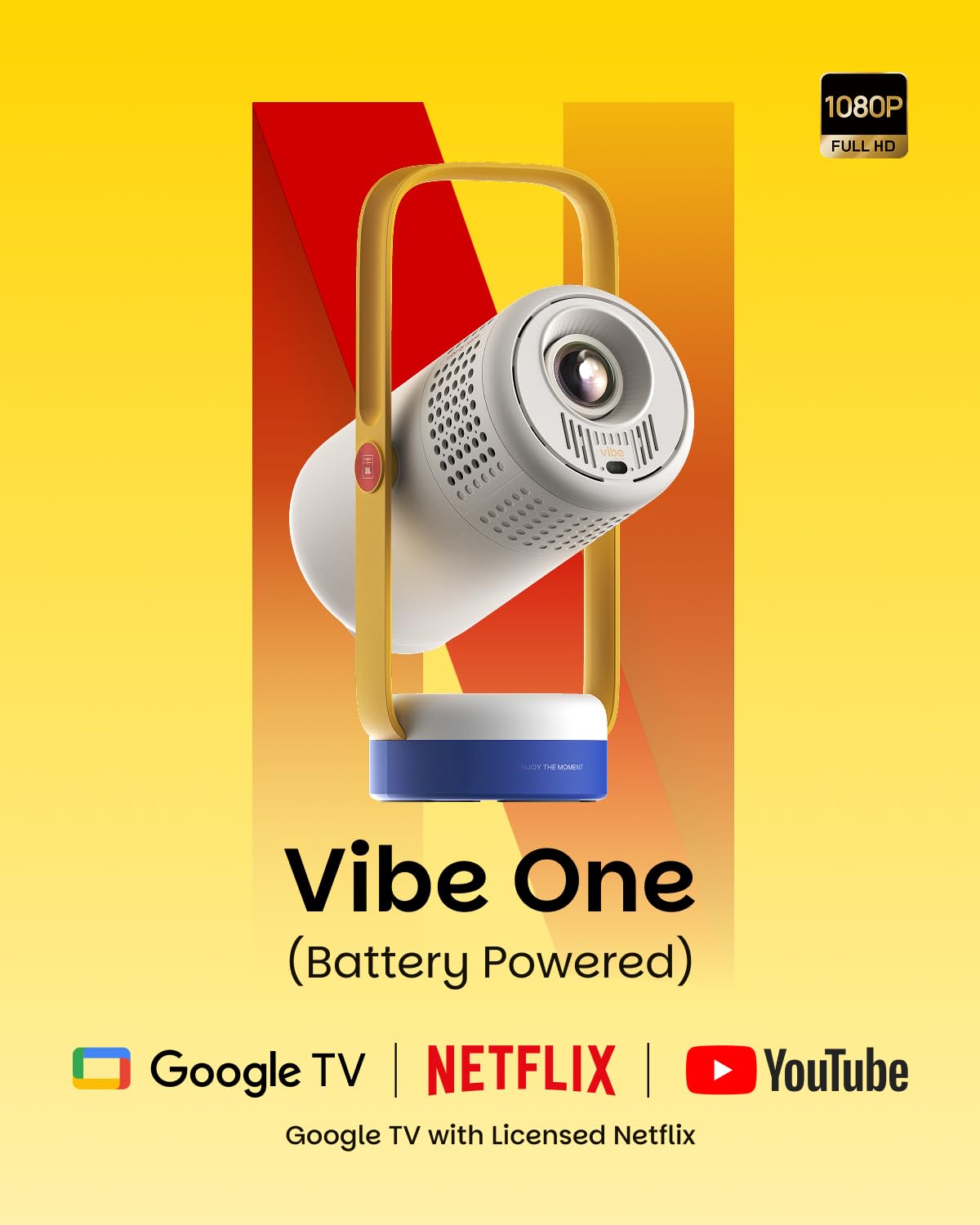

XGIMI Vibe One Battery-Powered Portable Projector
A portable 1080p LCD projector with a built-in battery, automatic focus and keystone correction, and a 160° stand that doubles as a carry handle. Its adjustable design makes temporary viewing appealing; its battery is better suited to an episode than a movie night.
Price
$189
Editorial rating
4.5 / 5
At a glance
One-line verdict
The Vibe One is an appealing grab-and-position portable projector, but video playback rated for up to 72 minutes in Eco Mode makes battery-powered movie nights a stretch.
Best for
Viewers who want an easily repositioned 1080p projector for casual viewing in different rooms.
Skip it if
You want to watch a full-length movie on battery power or need optical zoom to fit the image from a fixed position.
The full picture
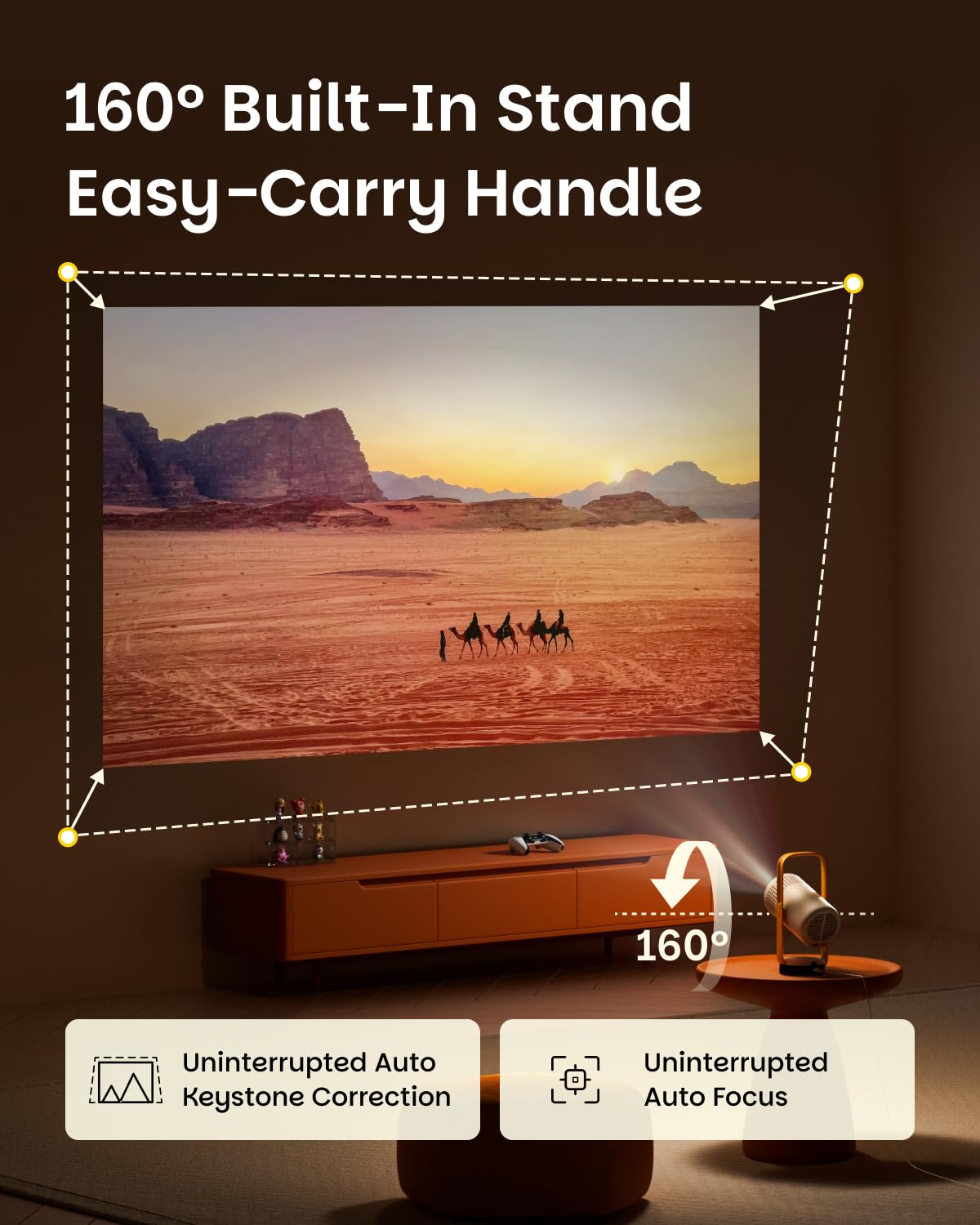
The XGIMI Vibe One makes its strongest argument before anything appears on the wall. Its carry handle becomes a stand with 160° of adjustment, giving the projector a practical answer to the question that follows most portable projectors: what are we going to prop this thing on? A stack of books should not have to audition for a home-theater role.
That design matters because temporary projection is largely an exercise in positioning. Move to another room, choose a different wall, or clear the table after dinner, and the setup changes. Its listed 1.4 kg—about 3.1 pounds—suggests carrying it around the house should be manageable. The adjustable stand lets you change its aim without treating every surface as a construction project. This is its most persuasive feature: portability that includes what happens after you put it down.
Uninterrupted autofocus and automatic keystone correction support that approach. They are intended to handle focus and straighten an off-axis picture as positioning changes. There are boundaries: XGIMI recommends keeping the side throw angle within 25° for accurate calibration, and complex environments can require manual correction. Think setup assistance, not permission to place the projector wherever an empty square inch happens to exist.
The picture starts with a native 1920 × 1080 LCD display and an LED light source. The listed image range stretches from 45 to 150 inches, but XGIMI's recommended 60–120 inches is the more useful planning range; it warns that going beyond it may affect image quality. There is no optical zoom, only digital zoom, and the throw ratio is 1.3:1. In practical terms, you should plan around where the projector can sit rather than assume a zoom lens will rescue the room layout. The adjustable stand changes the aim, not the optics.
Then comes the battery, which needs a much less romantic reading. Its 38.48 Wh capacity is rated for up to 1.2 hours of video in Eco Mode: 72 minutes, with brighter operation reducing that further. Unplugging automatically puts the projector into Eco Mode. That's useful for an episode, a short viewing session, or moving somewhere temporarily without power. It is not enough for most full-length movies. The credits may be the least demanding part of a film, but you still deserve to reach them.
One HDMI input and one USB input provide physical connection options. For longer viewing, plan on access to power rather than making the battery the centerpiece of the evening.
The Vibe One therefore makes more sense as an easily repositioned projector with a battery than as a fully cordless movie-night solution. Its stand, handle, and automatic adjustments address real annoyances of casual projection. If you value that flexibility and mostly watch near an outlet, there is a useful idea here. If your whole reason for choosing it is a feature film far from a socket, the runtime undermines the purchase.
The Irresistible
- The 160° stand doubles as a carry handle, addressing both transport and aiming in one genuinely useful design.
The Clever Part
- Uninterrupted autofocus and automatic keystone correction reduce the adjustment work involved in temporary setups.
- Native 1920 × 1080 resolution and a recommended 60–120-inch image range suit large-format casual viewing.
- One HDMI input and one USB input provide physical connection options.
The Fine Print
- No optical zoom: fitting the picture depends on physical placement and digital adjustment.
- Automatic keystone correction has placement limits; side angles beyond 25° or complex environments can require manual intervention.
The Reality Check
- Video runtime tops out at 72 minutes in Eco Mode, and brighter operation shortens it further—too little for most movies without external power.
Buyer questions answered
How long does the XGIMI Vibe One battery last for video?
XGIMI specifies up to 1.2 hours, or 72 minutes, of video playback in Eco Mode. Brighter operation reduces runtime, and the projector automatically starts in Eco Mode when unplugged.
What screen size does the XGIMI Vibe One support?
The listed image-size range is 45–150 inches, but XGIMI recommends 60–120 inches for the best viewing experience. It warns that going outside that recommended range may affect image quality.
Does the XGIMI Vibe One have optical zoom?
No. The Vibe One supports digital zoom but has no optical zoom, so physical placement remains important when fitting the picture to your wall or screen.
Does the XGIMI Vibe One focus and straighten the image automatically?
Yes. It supports uninterrupted autofocus and automatic keystone correction. XGIMI advises keeping the side throw angle within 25° for accurate calibration; complex environments may require manual correction.


CMYK Wavelength Party Game
CMYK Wavelength is a two-team social guessing game for 2–12 players, built around clues that place a hidden target between two opposing concepts. Your team tries to guess where you mean—a modest request until everyone discovers they interpret the same clue differently.
Price
$34.99
Editorial rating
4 / 5
At a glance
One-line verdict
Wavelength is a party game that makes interpreting your friends the main event, though its appeal depends on enjoying subjective clues rather than definite answers.
Best for
Friends and families with players age 14 and up who enjoy debating interpretations and want a team game that puts conversation at the center.
Skip it if
Your group prefers factual answers, independent puzzles, or decisions that don’t depend on interpreting someone else’s thinking.
The full picture
Wavelength turns a familiar social problem into a game: you know what you mean, and everyone else has somehow failed to appreciate how obvious it is. Here, that gap in interpretation is the entire point rather than an unfortunate turn in the dinner conversation.
The setup gives the disagreement a useful shape. A hidden target sits somewhere along a spectrum between two concepts. One player offers a clue to communicate its position, and their team tries to locate it. The closer the guess gets to the target’s center, the more it scores. You’re not merely asking whether someone understands a clue; you’re asking whether they understand its precise degree of meaning. Apparently, being roughly on the same page is no longer sufficient.
That makes Wavelength an appealing choice for people who like the conversation around a game as much as the result. The interesting work is in choosing a clue that other people will interpret as intended, then deciding what another person was trying to communicate. Knowing someone well gives you something to work with, but it also gives you ample reason to question their judgment. The mechanism turns those differences into material for play.
It also defines the main limitation. This is a subjective social exercise, not a test with a factual answer you can settle by remembering something correctly. A group that finds interpretation entertaining has a reason to engage; one that finds it arbitrary may spend the evening wishing for a different kind of challenge. Choose for the people at the table, not for the promise of telepathy.
The stated 2–12-player range makes it an option for both small gatherings and larger groups, with a manufacturer-listed average play time of 45 minutes. The recommended minimum age is 14, so its family-game appeal is aimed at teens and adults. For that audience, Wavelength offers a particularly focused game-night proposition: give people a reason to explain themselves, then make the explanation count.
The Irresistible
- The hidden-target spectrum makes degrees of interpretation matter, turning a simple clue into a revealing team discussion.
The Clever Part
- Supports 2–12 players, giving it a place at both smaller gatherings and larger game nights.
- Closeness-based scoring rewards a near miss rather than treating every imperfect guess alike.
The Fine Print
- The subjective clue-reading can frustrate players who want factual answers or less dependence on another person’s thinking.
Buyer questions answered
How many people can play Wavelength?
Wavelength supports 2–12 players and is structured as a two-team social guessing game.
How long does Wavelength take to play?
The manufacturer lists an average play time of 45 minutes.
What age is Wavelength recommended for?
The manufacturer recommends Wavelength for ages 14 and up.
How does Wavelength work?
Each round, one player gives a clue intended to place a hidden target along a spectrum between two concepts. Their team guesses the target’s position and scores more the closer its guess lands to the center.


Netatmo Indoor Outdoor Weather Station
A two-module weather station that measures indoor and outdoor temperature and sends both sets of readings to a Netatmo account over Wi-Fi. The indoor module also measures mean sea-level pressure. Useful for putting actual numbers behind the household debate about whether it’s colder outside.
Price
$110.50
Editorial rating
3.5 / 5
At a glance
One-line verdict
The Netatmo is a useful connected weather station for comparing conditions at home, provided you can give its outdoor sensor a shaded location with a reliable radio connection.
Best for
People who want indoor and outdoor temperature measurements sent to one account and have a suitable outdoor sensor location within radio reach of an indoor outlet.
Skip it if
You want a self-contained, battery-powered setup without an account or Wi-Fi connection, or your only outdoor mounting spot sits in direct sunlight.
The full picture
A weather forecast can tell you what’s happening around town. The Netatmo Weather Station has a narrower, more personal assignment: measuring temperature inside your home and at the spot where you place its outdoor module. That distinction is its reason to exist. A regional forecast is useful, but it has no particular interest in your patio.
The setup divides the work between two modules. The smaller outdoor unit sends measurements by radio to the indoor unit, which forwards both sets of readings to your Netatmo account over Wi-Fi. Both measure temperature; the indoor module also measures mean sea-level pressure. The appeal is bringing those local measurements together, not simply adding another source of weather predictions.
Power follows a practical split. The indoor module uses a USB wall adapter and cable, while the outdoor module takes AAA alkaline batteries. You don’t need to run a power cord outside, though the indoor unit needs an outlet nearby and the outdoor unit introduces batteries to maintain. “Wireless” has once again declined to mean absolutely everything.
Placement deserves more thought than choosing whichever shelf looks tidy. Netatmo advises keeping the modules out of direct sunlight, which can affect temperature accuracy. The outdoor module also needs a workable radio path to the indoor one: solid obstacles or a weak signal can interrupt transmission. Oddly, putting the modules only a few inches apart can cause trouble too. The goal is a representative, shaded measurement location with a reliable connection—not merely somewhere the sensor is out of the way.
This is a useful choice for someone who wants a connected record of conditions at home and is willing to arrange the setup around sensible sensor placement. It is less compelling if you just want a glanceable temperature gadget with no network or account involved. Choose the Netatmo for the relationship between indoor and outdoor measurements; don’t choose it expecting the location of those measurements to be an afterthought.
The Irresistible
- The two-module design brings indoor and outdoor temperature measurements together in one Netatmo account, giving weather information a genuinely local focus.
The Clever Part
- Battery power for the outdoor module avoids the need for an outdoor power cable.
- The indoor module adds mean sea-level pressure measurements alongside temperature.
The Fine Print
- Sensor placement is constrained by direct sunlight, radio reception, solid obstacles, and even excessively close spacing between modules.
- The indoor module requires outlet power, and the outdoor module requires AAA alkaline battery upkeep.
Buyer questions answered
How does the Netatmo outdoor sensor connect?
The outdoor module sends its measurements wirelessly to the indoor module, which forwards both modules’ measurements to the Netatmo account over Wi-Fi. Weak radio reception or solid obstacles between the modules can interrupt outdoor reporting.
How are the Netatmo weather station modules powered?
The indoor module uses a USB wall adapter and USB cable, while the outdoor module uses AAA alkaline batteries.
What does the Netatmo weather station measure?
Both modules measure temperature, and the indoor module also measures mean sea-level pressure.

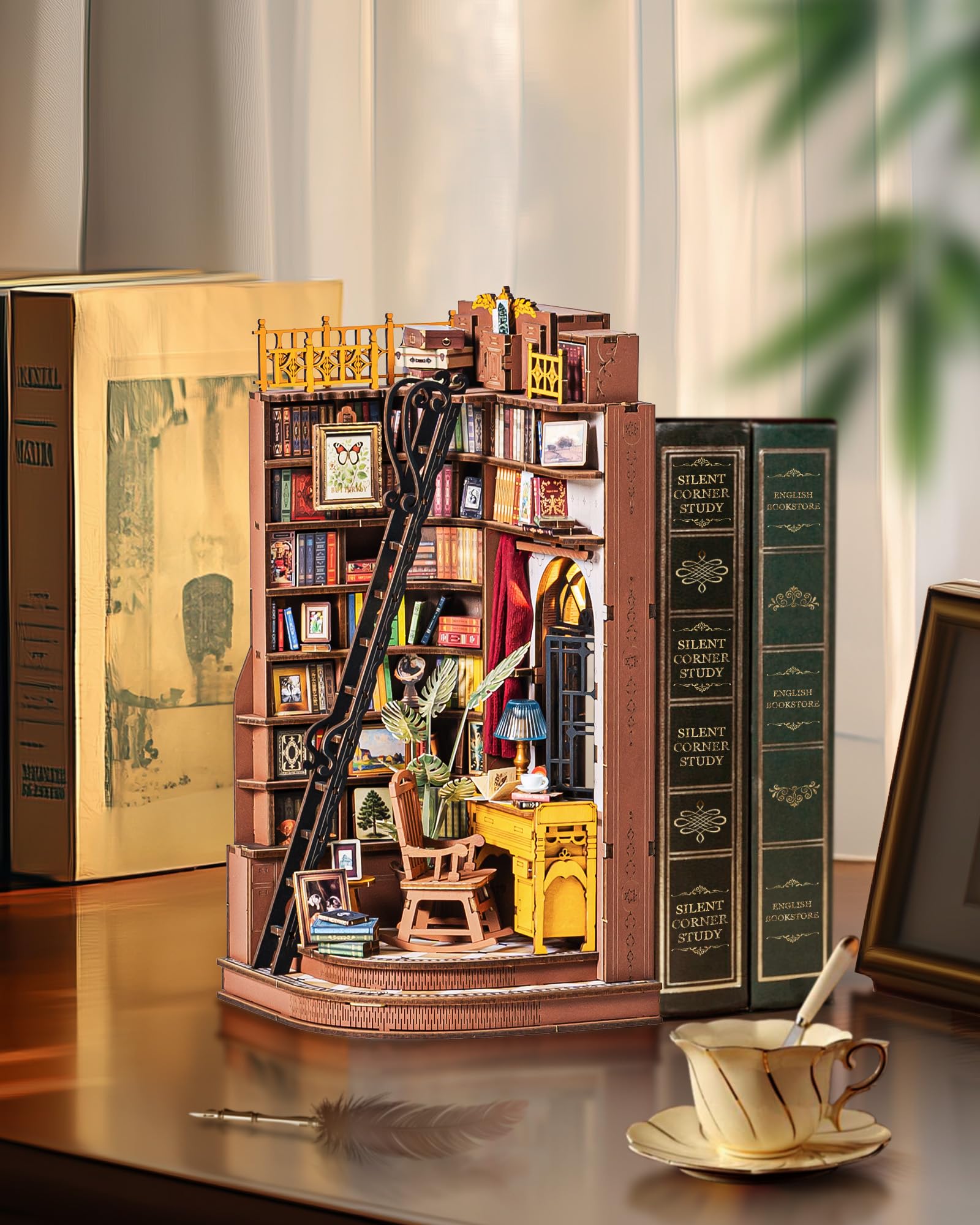

Rolife Silent Corner Study Book Nook Kit
A 196-piece wooden DIY book nook depicting a miniature study/library scene. The Rolife Silent Corner Study TGE02 turns a little shelf space into a room devoted to books—an appropriately recursive project for someone whose shelves are already full of them.
Price
$33.59
Editorial rating
5 / 5
At a glance
One-line verdict
A book-nook kit with a particularly fitting home among your books, provided you want the miniature-building project as much as the finished study.
Best for
Readers and miniature-building hobbyists who want a compact study scene to assemble and display on a bookshelf.
Skip it if
You want finished decor rather than a 196-piece project, or you need an explicitly beginner-level kit; Rolife rates this one three out of five for difficulty.
The full picture
A miniature library tucked among full-size books is a fairly specific decorating impulse. Rolife’s Silent Corner Study understands it: this wooden book-nook kit gives you a small study/library scene to build, then return to the shelf as though the books have acquired their own reading room.
The appeal has two parts, and you should want both. First comes the 196-piece assembly project; afterward comes the display. If you enjoy turning separate components into a recognizable little interior, the finished nook has a personal significance that ready-made decor doesn’t. If you only want something attractive between the novels, you’re signing up for a considerable preamble.
Rolife rates the TGE02 at three out of five stars for difficulty. That puts it in the middle of the manufacturer’s scale, not in the “surely this will assemble itself” category. Piece count alone doesn’t establish how demanding a model will be, but it does make the basic commitment clear: this is a craft project, not a decorative object with one final tab to insert. Choose it because arranging a tiny world sounds appealing, rather than because your shelf urgently needs filling.
The assembled dimensions are compact: 11.8 × 11.8 × 24.9 cm, or about 4.6 inches square and 9.8 inches tall. That footprint makes the study a plausible addition to an existing bookshelf rather than a model that demands its own display area. The height is worth checking against adjustable shelves before the miniature gets a better housing plan than you do.
There is also a light to account for: the instructions call for two self-supplied AAA batteries for testing it. Have those ready during assembly rather than treating them as a finishing-day errand.
The strongest reason to choose Silent Corner Study is its subject. A library scene belongs among books without needing an explanation, and its compact format lets the hobby and the decor occupy the same space. For a reader who also likes making things, that’s a persuasive combination. For someone who dislikes assembly, it’s homework with unusually small architecture.
The Irresistible
- The study/library scene gives the finished miniature a natural setting among real books, connecting the build to its eventual display.
The Clever Part
- The roughly 4.6-inch-square footprint accommodates a detailed miniature project without requiring a separate display area.
- A 196-piece wooden build offers a hands-on activity as well as a finished decorative object.
The Fine Print
- The light-testing step requires two AAA batteries that you must supply separately.
Buyer questions answered
How many pieces does the Silent Corner Study kit have, and how difficult is it?
The kit contains 196 pieces, and Rolife lists its difficulty as three out of five stars. Treat it as an involved miniature-building project rather than instant shelf decor.
What batteries does the Rolife Silent Corner Study need?
The assembly instructions specify two self-supplied AAA/LR03/AM4 1.5V batteries for testing the light.


Atari 2600+ Retro Game Console
The Atari 2600+ plays most Atari 2600 and 7800 cartridges through HDMI, pairing an old-fashioned cartridge slot with modern emulation. A CX40+ joystick and 10-in-1 cartridge come included. It preserves the part of retro gaming that involves actually picking something off a shelf.
Price
$159.74
Editorial rating
4.5 / 5
At a glance
One-line verdict
The Atari 2600+ is a compelling retro console for cartridge-minded nostalgists, but compatibility is not guaranteed for every Atari 2600 and 7800 cartridge.
Best for
Atari fans with 2600 or 7800 cartridges, and newcomers who specifically want the physical cartridge-and-joystick experience rather than just access to old games.
Skip it if
You need guaranteed compatibility with every cartridge, insist on original hardware rather than emulation, or have no particular attachment to physical Atari games.
The full picture
The Atari 2600+ makes sense if choosing a cartridge is part of what you miss. Not just the games, but the small ceremony: deciding what to play, putting it in a console, and committing to it rather than scrolling past it. This is a modern retro console built around that distinction. If a cartridge is merely an inconvenient container to you, much of its appeal has already left the room.
Its strongest feature is support for both Atari 2600 and Atari 7800 cartridges. That gives an existing collection a practical reason to come off the shelf and gives a newcomer two related libraries to explore. The included 10-in-1 cartridge also means you don't need to assemble a collection before you have anything to play. Alongside it is a CX40+ joystick: an appropriately direct starting point for a machine whose appeal does not depend on navigating an elaborate dashboard.
HDMI is the useful concession to the present. You can connect the console to a modern TV without making vintage video connections a separate hobby. An HDMI cable is included, as is a USB-C power cable, although you'll need to supply a power adapter. There's also a widescreen mode. Whether you want that option is a matter of presentation preference; its presence is not a reason to expect more detail from these old games.
The hardware is smaller than its inspiration, at 80% of the original Atari 2600's size, with dimensions of 10.63 × 7.09 × 2.76 inches. That's a welcome middle ground for this particular object. It remains a console you can physically interact with, rather than a miniature tribute whose main job is to be recognized. DB9 controller connections keep the controller interface rooted in the same physical approach.
There is an important distinction under that nostalgic exterior: the 2600+ uses emulation software, including Stella and ProSystem. The cartridge ritual is real; the internals are modern. That isn't inherently a drawback for someone who wants to play their games through HDMI, but it matters if your goal is original hardware behavior rather than a contemporary way to revisit the format.
The firmer limitation is cartridge compatibility. Atari says it supports “most” 2600 and 7800 cartridges, not all of them. For someone buying around a particular collection, that qualifier carries more weight than the console's appearance or bundled game count. This is not a universal replacement for every Atari setup, and a favorite cartridge should not be treated as guaranteed to work.
For the right buyer, though, the proposition is distinctive and convincing. The 2600+ preserves a tactile way of choosing and playing games while removing the old television connection from the equation. Its appeal isn't that it makes Atari gaming newly sophisticated. It's that it lets a cartridge be the evening's entertainment again, without requiring the television to be a museum piece too.
The Irresistible
- Support for most Atari 2600 and 7800 cartridges gives physical collections a useful route to an HDMI-equipped TV.
- The cartridge slot and included CX40+ joystick preserve the hands-on appeal that a menu of retro games cannot replace.
The Clever Part
- An included 10-in-1 cartridge provides a starting point without requiring a separate game collection.
- The reduced-size console keeps the physical format while taking up less space than the original.
- HDMI and USB-C power cables are included.
The Fine Print
- No power adapter is included, so the supplied USB-C cable does not complete the power setup.
The Reality Check
- Compatibility is not guaranteed for every Atari 2600 and 7800 cartridge—a significant caveat if you're buying it for a particular collection.
Buyer questions answered
Does the Atari 2600+ play original Atari cartridges?
Yes. It plays most Atari 2600 and Atari 7800 cartridges, but compatibility is not guaranteed for every game.
Does the Atari 2600+ connect to a modern TV?
Yes. The Atari 2600+ outputs video over HDMI, and an HDMI cable is included. It also offers a widescreen mode.
What comes with the Atari 2600+?
The standard package includes the console, a CX40+ joystick, a 10-in-1 game cartridge, an HDMI cable, and a USB-C power cable. A power adapter is not included.
Does the Atari 2600+ use emulation?
Yes. The Atari 2600+ plays cartridges using emulation software, including Stella and ProSystem; it is not a recreation of the original console's internal hardware.
How big is the Atari 2600+?
The console measures 10.63 × 7.09 × 2.76 inches and is described as 80% of the original Atari 2600's size.